Wednesday, November 2, 2016

New Paintings


 Simple still life with a plane-linear 
color patch approach.
This isn't everything, but it gives you an idea of some of the work done in and outside of class over the past few weeks.

This was another still life study where the objects had to be white and identified with subtle hues within the white.


Here's my product from attending the Alex Folla "Caravaggio Workshop." It focuses on glazing over a dark background. The image is defined by glazing with a light hue; leaving a light coating over an area constitutes as "dark". So, in a sense, the artist is painting the dark areas, as well as the light ones, with white.


Even though glazing in the tradition of the Renaissance artists is not my preferred method/style, the Alex Folla workshop did inspire me to go back to that time honored technique and apply it to a portrait. This piece has a lighter brown under-painting and is obviously in process: a few more layers of glazing to go (Titian's approach). As far as I'm concerned, this is an easier way to paint than compared to direct painting.

Here's some further development on the portrait. I added detail to the facial features, but had to redo the skin tone of the body (made the mistake of not varnishing the ground and that pigment was bleeding into the glazing). The piece was done on a larger panel, so I came up with the idea of a "hand portrait" in juxtaposition. That image has a lot more work to be done on it.


Yeah, another modification. I had to redo her skin entirely. Lost the purity of the facial features as a result. But, with some more tweaking, I should be able to get the skin tone right and restore the features.

On the other hand (ha, ha!), had success with my hand. Pretty daring with the lime green background (I'll wait for comments from my crit group on that).


Here's the final for my painting class. Four panel landscape with a twist. I used two images from a video clip from my world bicycle tour: a ride along the Rhine River Radweg. I'm saving the hardest part for last...the figures.
The finished product has a unique conveyance of time, motion, and composition interplay. I used a palette similar to that of Fairfield Porter (though not as heavy a value contrast). Some adjustments had to be made to subjects with red-orange to avoid a predictable repetition. Shadows had to be altered as well, to maintain the cool side of hue selection.

The work in this class has taken me back to the basics and helping me to sharpen my skills.

Wednesday, October 19, 2016

First Three Completed


These pieces represent what I've been doing in my studio time. I'll share with you some of my classwork from metals, painting, and computer graphics in the weeks ahead.


In this unusual self portrait, I defined the figure and broke up the "frame" around the image by extending content through to the edge. I also darkened some areas, especially in the upper background, to create greater contrast and drama. I found that in order to restore the white of the fish skeleton, I had to grind it out with a dremel and decided to keep some of it open to give a greater sense of dimension.


I incorporated the figure into this piece: images taken from old family photos of relatives from my Armenian side. The fact that the partial self-portrait on the lower right happens to look angry is purely incidental. I also enhanced some of the color and lowered the value scale at some key points.


This portrait of Graham was easy to finish: light pigment mixed with the plaster and apply where needed. Added a little fabric dye to incorporate more color and a little texture. I only had to brush a little watercolor in areas that were too open. Sealed with the Polycrylic and called it done.

Friday, September 9, 2016

Three Weeks of Studio Production

Here are three pieces that I've been working on since having been issued a studio space in the Strassner off-campus building.
"Back to Fish 2" This is a remake of a piece I did several years ago (a favorite which was accidentally destroyed). I've got to make some adjustments on the left arm and do much more glazing.

"Celestial Tree" This abstract composition just received its first layer of glazing and will have a few "ghost-like" images, from very old family photos, drawn/sketched in various places, and in varying scale, on the picture plane.

"Graham" This portrait, of the brother of a former student of mine, is in the first stages of development: initial squirted plaster line, added texture, black paint over texture to create a fine ridge-line delineation, after future sanding. 


Wednesday, August 17, 2016

Course #2: Chinese Ink Drawing and Watercolor

The following images are some of the results from the second Summer session I took at Fontbonne. Very beneficial experience. I learned how to REALLY draw/paint bamboo!

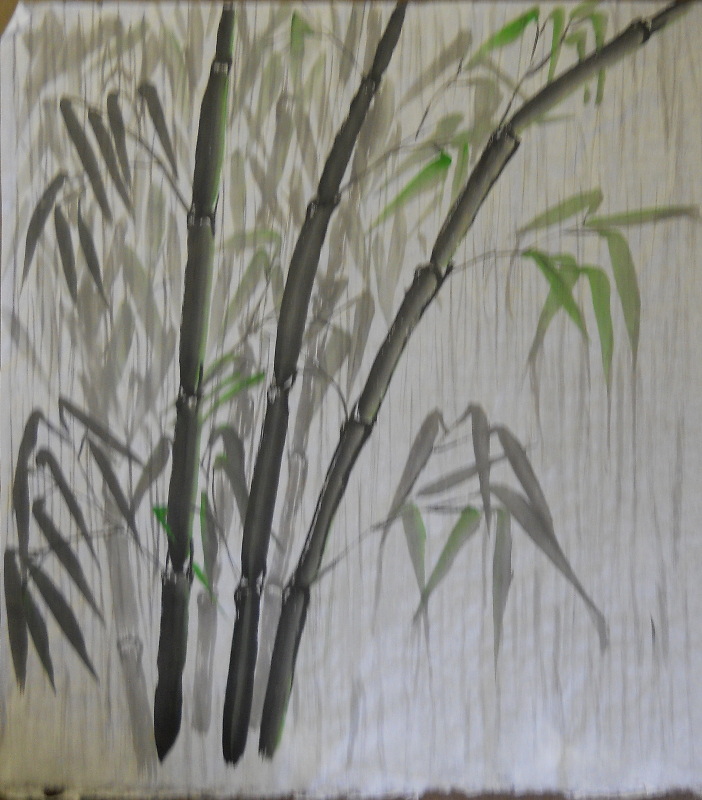
Bamboo in the rain

A story about a deadly hawk hidden in beauty and an unsuspecting field mouse, as prey.

Inspired from another image of a nuthatch on pine branch.

Basic orchid with "almond eye" leaves.

The "fourth gentleman" is Lotus. This quick study includes a partially obscured koi.

Magpie on bamboo, with my signature/stamp.

Tuesday, July 5, 2016

Summer Ceramics


Unique Raku glazes
Here are a few samples of the pottery I created in ceramics course at Fontbonne. It lasted only 4 weeks, with a primary focus on throwing on the wheel, some hand building, Raku firing, and Black Pottery of the American South West.
10" Peacock Vase


Raku container with lid

Small pot with embedded clay pieces on the side.

Stoneware pot with layered green glazes.

Naked Raku vase
Native American Black Pottery

Two white Raku crackle


Wednesday, June 1, 2016

More Big Changes

Sorry for taking so long to post something. These recent months have not been very art productive. But, I have had a productive year of teaching. In fact, it's been the best year of my teaching career with wonderfully enjoyable classes!
Here's a sample of some of the students that made it such a fun year for me:


Delightful Mary, who thinks that her charming disposition earns her free snacks.
 5th hour Art 1, where I got to say multiple "No's" and rip up their art work...every half a minute. Sorry for leaving out the Seniors (they had the privilege of getting out of school before finals).
The very sassy 4th hour Art 1 class, who had mevin wrapped around their finger.


 Sarah sporting the "W--- T---" crown gift. Along with Christine who was equally as proud of her most excellent hand built container.
Ty in fractal distortion.
I've replaced Alex' fractal photo with an image of his 1st place prize winning Japanese print, as recognized by the Webb City Public Library Invitational Printmaking Competition 2016.

Here is a very small sample of this years art work:
Abbi's Glass Mosaic

The scrap book art bulletin board.


Caitlin's Glass Mosaic
And an Art Appreciation group shot (minus the seniors) plus a couple of 2016 graduate hugs...
Ty and Jon at the Crystal Bridges field trip


With much sorrow, I did resign from CHCS. I feel like this next year is the last chance that I'll have to earn my MFA. So, I'm living back in St. Louis and will start my first Summer session June 6th. I'm not sure how the Lord will put that degree to use, but I feel compelled to work toward its accomplishment.
Part time work has yet to be determined. Any extra time that I do have will be spent working on the WKY homestead. Yeah, that's a retirement dream of a self sustaining, renewable energy, hobby farm...which will hopefully be up and running by the time I reach that magic age!

Saturday, January 2, 2016

Favorite Quotes from Steven Pressfield's "The War of Art"


Although this book is a little too Zen and has some colorful language, it was personally inspirational and interprets the spiritual battle of the artist in a new metaphorical way.

You know, Hitler wanted to be an artist. At eighteen he took his inheritance, seven hundred kronen, and moved to Vienna to live and study. He applied to the Academy of Fine Arts and later to the School of Architecture. Ever see one of his paintings? Neither have I. Resistance beat him. Call it overstatement, but I’ll say it anyway: it was easier for Hitler to start World war II than it was for him to face a blank square of canvas.  (end of intro)

Resistance will come in reaction to any act that rejects immediate gratification in favor of long-term growth, health, or integrity. Or, expressed another way, any act that derives from our higher nature instead of our lower. Any of these will elicit Resistance.  (p.6)

Resistance is not a peripheral opponent. Resistance arises from within. It is self-generated and self-perpetuated. Resistance is the enemy within. (p.8)

Resistance will tell you anything to keep you from doing your work. It will perjure, fabricate, falsify; seduce, bully, cajole. Resistance is protean. It will assume any form, if that’s what it takes to deceive you. It will reason with you like a lawyer or jam a nine-millimeter in your face like a stickup man. Resistance has no conscience. It will pledge anything to get a deal, then double-cross you as soon as your back is turned. If you take Resistance at its word, you deserve everything you get. (p.9)

Like a magnetized needle floating on a surface of oil, Resistance will unfailingly point to true North—meaning that calling or action it most wants to stop us from doing.
            We can use this. We can use it as a compass. We can navigate by Resistance. Letting it guide us to that calling or action that we must follow before all others.
            Rule of thumb: the more important a call or action is to our soul’s evolution, the more Resistance we will feel toward pursuing it. (p.12)

            Resistance has no strength of its own. Every ounce of juice it possesses comes from us. We feed it with power by our fear of it.
            Master that fear and we conquer Resistance. (p.16)

            Resistance obstructs movement only from a lower sphere to a higher. It kicks in when we seek to pursue a calling in the arts, launch an innovative enterprise, or evolve to a higher station morally, ethically, or spiritually.
            So if you’re in Calcutta working with the Mother Teresa Foundation and you’re thinking of bolting to launch a career in telemarketing…relax. Resistance will give you a free pass. (p.17)

            The most pernicious aspect of procrastination is that it can become a habit. We don’t just put off our lives today; we put them off till our deathbed.
            Never forget: this very moment, we can change our lives. There never was a moment, and never will be, when we are without the power to altar our destiny. This second, we can turn the tables on Resistance.
            This second, we can sit down and do our work. (p.22)

            The counterfeit innovator is wildly self-confident. The real one is scared to death. (p.39)

            The more Resistance you experience, the more important your unmanifested art/project/enterprise is to you---and the more gratification you will feel when you finally do it. (p.42)

            Resistance doesn’t want us to face our fears. So it brings in Rationalization. Rationalization is Resistance’s spin doctor.  (p.55)

            The professional, on the other hand, understands delayed gratification. He is the ant, not the grasshopper; the tortoise, not the hare.  (p.75)

            The professional respects his craft. He does not consider himself superior to it. He recognizes the contribution of those who have gone before him. He apprentices himself to them.
            The professional dedicates himself to mastering technique not because he believes technique is a substitute for inspiration but because he wants to be in possession of the full arsenal of skills when inspiration does come. The professional is sly. He knows that by toiling beside the front door of technique, he leaves room for genius to enter by the back.  (p.84)

            The author uses and approves of Jungian concepts, and finds helpful a distinction between Self and Ego:
            The Ego hates artists because they are the pathfinders and bearers of the future, because each one dares, in James Joyce’s phrase, to “forge in the smithy of my soul the uncreated conscience of my race.”
            Such evolution is life-threatening to the Ego. It reacts accordingly. It summons its cunning, marshals its troop.
            The Ego produces Resistance and attacks the awakening artist.  (p.41)

            The artist is the servant of that intention, those angels, that Muse. The enemy of the artist is the small-time Ego, which begets Resistance, which is the dragon that guards the gold. That’s why the artist must be a warrior and, like all warriors, artists over time acquire modesty and humility. They may, some of them, conduct themselves flamboyantly in public. But alone with the work they are chaste and humble.  (p.163)